Generation Y has a faint cultural memory of Christianity

There was a very interesting article on the Church of England website yesterday:

“Young people have not inherited the rebellious hostility to the Church of their parents’ generation, although for many of them religion is irrelevant for day-to-day living. These are two of the findings of an informative new book The Faith of Generation Y, authored by Sylvia Collins-Mayo (sociologist of religion), Bob Mayo (parish priest in West London), Sally Nash (Director of the Midlands Centre for Youth Ministry) with the Bishop of Coventry, Rt Revd Christopher Cocksworth (who has five Generation Y children).

Reporting a study of over 300 young people in England aged between 8 and 23 who attended Christian youth and community work projects in England, The Faith of Generation Y (those born from around 1982 onwards) provides an empirically grounded account of the nature of young people’s faith – looking into where they put their hope and trust in order to make life meaningful. The book goes on to consider whether Christianity has any relevance to young people, and asks whether the youth and community projects in which they participate foster an interest in the Christian faith.”

Read the full article here.

Tim Challies – The truth about Wikipedia

Wikipedia-logo

Tim Challies has been reflecting on the good and bad of a ‘wiki’ view of the world and more specifically Wikipedia – looking at how it handles, defines and redefines what is considered as ‘truth’ in our contemporary culture:

“God is true. God is truth. God is entirely without error, entirely true in all he is, in all he knows, in all he commands. He is the source of all that is true and right. As beings made in his image, we are to reflect his truth, to value what is true and turn from what is error. Truth leads to God, error leads to Satan, for it is Satan who is the first liar and the father of lies (John 8:44). Wayne Grudem offers this warning: “In a society that is exceedingly careless with the truthfulness of spoken words, we as God’s children are to imitate our Creator and take great care to be sure that our words are always truthful.” Lying is an abomination to God because it mocks his truth. And while factual errors may not carry the same level of moral culpability as outright lies, while they may be unintentional, they are still lies, still pointing to a false reality. They still dishonor God.”

As he continues:

“…I thought about how we encounter truth in the world today, how we determine what is true and what is false. And naturally my thoughts led me to Wikipedia. It led me to pour a lot of thought into Wikipedia and into the reality that Wikipedia may well now be our culture’s primary arbiter of truth. What does this mean to the Christian? Is Wikipedia a source of truth? And what does it mean that as a society we now believe that a wiki model is the best way to determine what is true?”

Read his full post in two parts – part one here, part two here.

Tim Keller – Preaching hell in a tolerant age

Tim_keller

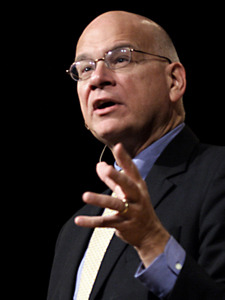
Tim Keller posted a really insightful article on SermonCentral about preaching hell in a tolerant age:

The young man in my office was impeccably dressed and articulate. He was an Ivy League MBA, successful in the financial world, and he had lived in three countries before the age of thirty. Raised in a family with only the loosest connections to a mainline church, he had little understanding of Christianity.

I was therefore gratified to learn of his intense spiritual interest, recently piqued as he attended our church. He said he was ready to embrace the gospel. But there was a final obstacle.

“You’ve said that if we do not believe in Christ,” he said, “we are lost and condemned. I’m sorry, I just cannot buy that. I work with some fine people who are Muslim, Jewish, or agnostic. I cannot believe they are going to hell just because they don’t believe in Jesus. In fact, I cannot reconcile the very idea of hell with a loving God—even if he is holy, too.”

This young man expressed what may be the main objection contemporary secular people make to the Christian message. (A close second, in my experience, is the problem of suffering and evil.) Many today reject the idea of final judgment and hell.

Thus, it’s tempting to avoid such topics in our preaching. But neglecting the unpleasant doctrines of the historic faith will bring about counterintuitive consequences. There is an ecological balance to scriptural truth that must not be disturbed.

If an area is rid of its predatory or undesirable animals, the balance of that environment may be so upset that the desirable plants and animals are lost—through overbreeding with a limited food supply. The nasty predator that was eliminated actually kept in balance the number of other animals and plants necessary to that particular ecosystem. In the same way, if we play down “bad” or harsh doctrines within the historic Christian faith, we will find, to our shock, that we have gutted all our pleasant and comfortable beliefs, too.

The loss of the doctrine of hell and judgment and the holiness of God does irreparable damage to our deepest comforts—our understanding of God’s grace and love and our human dignity and value to him. To preach the good news, we must preach the bad.

But in this age of tolerance, how?

Read the full article here.

Britain still claims to be 71% Christian

Interesting article in the Daily Mail today about the sexual and religious make up of Great Britain:

More than seven out of ten Britons say they are Christians, according to an official count.  The high figure will be seen as a firm endorsement for those who argue the British public remain wedded to traditional religious values despite the fall in church attendances…..The analysis produced by the Office for National Statistics suggested that a big majority of the population still believe in Christianity.  Based on nearly 450,000 replies to a series of Government-backed surveys, it found that 71.4 per cent of the UK adult population call themselves Christians.  They dwarfed the numbers of atheists and secularists. Just over one in five people, 20.5 per cent, said they had no religion.  The analysis from the new Integrated Household Survey, which is produced from answers to the same questions put in six different established surveys, put the Muslim proportion of the population at 4.2 per cent, just under one in 20.  It said 1.5 per cent are Hindu, 0.7 per cent Sikh, 0.6 per cent Jewish, 0.4 per cent Buddhist, and 1.1 per cent say they follow another religion….

Read the full article here.

Dismantling the ‘cathedral of the self’

Durham_cathedral_inside

In a recent post on his blog, ‘The Flaying of the Missional Church Upon The Cathedrals of the Self‘, Mark Sayers’ leaves a challenge to the missional church movement, namely:

The church moves into the cafe, the pub, the home, and the sporting club in the name of mission and as a protest against attractional concepts of Church. Yet the individual sense of entitlement is never truly challenged, there will be much focus on the immanent Jesus who is our friend, yet little emphasis on the transcendent ‘otherness’ of God who reminds us of our falleness and cosmic smallness. The huge danger is that whilst the incarnational, missional approach rejects the idea of the medieval cathedral, the cathedral of the self is never truly dismantled.

As he explains earlier in the post:

The individual now operates as a kind of personal cathedral. Social media arms and aids the growing sense of entitlement in the contemporary therapeutic self. The individual creates a facade that will shock and awe. An exterior that will garner respect and acknowledgement. If the medieval cathedral was an attempt to connect with a palpable sense of the transcendent, the contemporary self attempts also attempts to create a sense of transcendence through the correct assemblage of consumer experiences.
The difference between this and the medieval vision is that the contemporary cathedral of the self is religion free, instead it seeks to eek out transcendence in what David Brooks calls a ‘low-ceilinged world’. Instead of plainchant, stained glass windows and the drama of the liturgy, the modern self attempt to find transcendence in budgets breaks on the beach in Thailand, 3D movies, killer Ipad apps, and in the torque of a SUV.
The cathedrals of the 21st century self like their medieval counterparts demand that you come to them. They demand to be taken seriously. They insist on being the only show in town. Therein lies the danger for the missional church. The missional church which attempts to incarnate, which tries to ‘go to’; can find itself shifting from an attractional mode of church, to becoming enslaved to an attractional view of the self. Incarnation can quickly degenerate into syncretism for the missional operator who is unaware of the cathedral of the self.
Many missional leaders who have critiqued the therapeutic and individualist tendencies of the contemporary church growth movement, can easily and naively find themselves serving an even more pernicious expression of the therapeutic self as Church is completely taken to and rearranged around the habits, locales, tastes and wants of the individual in the name of incarnational mission.

This is well observed and to the point – just because a congregation has moved out into community and no longer meets in a church building doesn’t mean that they have moved away from an attractional construct of church.  They might consider themselves ‘incarnate’, meeting together amongst the people group that they feel called to reach, and yet still live ‘enslaved to the attractional view of the self’ because they haven’t come to terms with the transcendent otherness of God, the King who should be feared and obeyed above all else, and truly recognised their eternal dependence upon Him rather than on disposable and transitory, worldly pleasures.

I think this is a real problem for the church in its contemporary context – or should I make it more personal and admit that it is a real problem for me in my personal context.  Is Jesus really Lord and King of every area of my life?  Have I truly experienced first hand the fear of God that is the beginning of wisdom (Ps 111:10)?

I have just been watching the first of the Francis Chan BASIC series – amazingly entitled ‘Fear God’.  I intend to review it more fully over the next few days, but it has really hit home to me how much I need to get to a proper understanding of the fear of God – and put my understanding of the ‘immanent Jesus who is my friend’ into it’s correct context.

Alan Hirsch and Michael Frost in their book ReJesus encourage the viewing of discipleship from a Hebraic perspective, focussing on the concepts of orthodoxy, orthopraxy and orthopathy – right thinking, right acting and right feeling.  It occurs to me now upon reflection, and after reading Mark’s post, that none of these adequately incorporate our response and attitude towards the holiness of God.  Maybe another should be added – how about ‘orthodikasy’ (yep, I just made it up but it sort of works) – which I will define as our ‘right standing’ before God.  I think this would complement the Hirsch-Frost Hebraic framework – and acknowledges the need for a proper understanding of the otherness of God in the missional context.

Francis Chan – BASIC series

Francis_chan_basic

A friend drew my attention to the new Francis Chan DVD’s called the ‘BASIC series’ – being produced by Flannel, the same crowd that produced the NOOMA videos with Rob Bell:

Check out the BASIC series website here.

Trends come and go in our culture and the church seems to follow.

Francis Chan asks these questions about the church. Francis puts it this way:

“If I only had this as my guide… if all I had was the Bible…and I was to read this book and then start a ‘church’ what would it look like? Would it look like the thing that we’ve built here and all refer to as church? Or would it look radically different?”

BASIC is a seven part series of short films – from Flannel, the award winning creators of the NOOMA film series – that challenge us to reclaim the church as Scripture describes it to be. This series will speak to those who have questions about the church and to those who may have lost interest in the church.

What is church?
You are church.
I am church.
We are church.

Here is the series trailer:

…and the trailer for the first DVD in the series, Fear God, which is available now here.

I have just bought it and will review it next week once I’ve received it through the post and watched it 🙂