Do some ‘earthly good’

Here are some interesting thoughts from Chris Erdman’s ‘Awaking the spiritual life’ blog about living a contemplative life:

Active people often have serious criticisms of the word “contemplative.” It sounds monkish, escapist, elitist. A friend recently said, “Aren’t contemplatives so heavenly minded, they’re no earthly good. Mine is an active life. Jesus would never have entered a monastery.”

If that’s what the contemplative life is then she’s right, let’s have nothing to do with it. But it’s not. That’s a caricature, not the real thing.

The contemplative life is the path of true compassion, and therefore the way of real, redemptive action in the world (Dag Hammarskjold is among the best, modern and public examples……

“Contemplation” and “contemporary” come from the same Latin roots: “con” meaning “with,” and “tempus,” or “time.”

So, “contemplative” simply means being truly “contemporary”–that is, fully here, now, immersed in the present. That can’t, by definite or practice, be escapist. Contemplatives, then make the best engineers and airline pilots, surgeons and chefs, mothers and teachers. Contemplative living is noble living.

Jesus did not cloister himself away in a monastery. But that that doesn’t mean he wouldn’t have gone there periodically. Was not his forty days in the wilderness a monastic retreat? And St. Paul’s years also, when he was hidden away in Arabia (Galatians 1.17)?

The monastery’s prepared many of those who’s worldly actions have matter most in our world.

Contemplation is an art. Learn it and you’ll do some “earthly good.”

Good points – well made.

Any thoughts?

Read the full article here.

Does God love the sinner but hate the sin?

It’s a common phrase that you hear banded about in Christian circles:

‘God loves the sinner but hates the sin’

I’ve thought about it a lot over the years – and probably a number of you have heard me talk about it….and some will be bored with hearing me talk about it, no doubt!

The question is – is it Biblical?

Personally, I don’t think it is – and what’s more I think the phrase is partronising and self-righteous – and those who use it have forgotten that they are also sinners in need of God’s grace.

It’s moralism gone crazy in my book!

No-where in the Bible does God separates the status of a sinner from their sin – and it is ‘whilst we were yet sinners that Christ died for us’!

God accepts us and loves us as sinners who sin – not because of what we have done or not done – but in Christ by his grace through our faith in his saving death and resurrection – this is incredible stuff!!!

Therefore, to say that God loves the sinner but hates the sin makes no Biblical or doctrinal sense whatsoever!

With this in mind, it was encouraging to read a post on the Euangelion blog (here) saying pretty much the same thing:

Recently I was driving on a highway in upper Wisconsin on a weekend away with the wife. Plastered on the side of a barn visible to everyone that drove by was the oft quoted evangelical proverb “Love the Sinner, Hate the Sin”. I have been reflecting on this idea for a while now and the more I think about it the more I realize it is by and large the basis of the evangelical community’s relationship to the world. It  of course seems to capture the essential ideas of God’s love for his fallen world, but as I have rolled this over in my mind I’m growing in my doubt about whether this is really a biblical concept for two reasons. 
First, the concept inappropriately separates deeds from person. The Bible seems to rather point the opposite direction: our deeds are  a reflection of who we are.  I find it all to common that people rationalize  deviant behavior with the thought “this isn’t  really me”.  My retort is: “No this is you. And until you embrace that fact there can be no growth”. In my view, the mirror reflection of one’s identity is one’s deeds. 
Second, the perspective seems to undermine the radical message of Paul’s Gospel of God’s love for sinners. This is particularly pointed when I consider Romans 5:8-10:
But God demonstrates his own love for us in this: While we were still sinners, Christ died for us. Since we have now been justified by his blood, how much more shall we be saved from God’s wrath through him! For if, when we were God’s enemies, we were reconciled to him through the death of his Son, how much more, having been reconciled, shall we be saved through his life!
These verses suggest to me that God doesn’t divide between person and deeds. God loves sinners full stop.

This makes sense to me, and I’ve come to a similar conclusion – God loves the sinner full stop!

How?

In Jesus – through his death on the cross and resurrection from the tomb.

Thats what the Bible says – and thats what we should preach!

‘God loves the sinner and died on the cross at Calvary in order to deal with the sin’

Now thats a truth worth preaching, eh?

Where has the last week gone?

Busyness

Unbelievable!  Why do we allow ourselves to get so busy?

I know, for most of us it probably isn’t a deliberate decision.  It just sort of happens.  One minute we seem to have a few things to do and then…..bang!  Suddenly we find ourselves running around all over the place trying to catch up!  Or worse, running as fast as we can just to stand still….

Maybe it’s just me.  Maybe this isn’t your experience.  Maybe you’re more disciplined and time aware than I am.

But for me, the last few days have been hectic – and I look back now and wonder where the time has gone.  I have done so much, and yet don’t seem to have any real sense of satisfaction or achievement.

The thing is, and this is important, when we get really, really busy we start to lose our sense of priority.  We focus on what is in front of us, head down, rather than looking up and putting what we are doing in the context of everything else.  This eventually ends up with us feeling empty, because we become disorientated and lose the sense of how what we are doing fits in to the big picture of our lives.

Keep this up and you become tired, inefficient and ineffective – and then you forget or ignore the things that are actually most important – such as time to rest, time to be with our family, time to meditate and be with God.  Our usual disciplines and rhythms go out of the window – and yet it is these very disciplines and rhythms that we need, because they keep us grounded, and our lives in context, stopping us from losing it, running ourselves into the ground.

Eventually, our bodies tell us to slow down anyway, whether we like it or not, by our becoming ill, or depressed.  Why?  Because we can’t keep up with the pace perpetually without something breaking.

So the answer is to make ourselves slow down a little – just enough to maintain balance and remember our priorities 

So this is just me, reflecting on my week, making mental notes to slow down, to focus on balance and to get my priorities right.

Reading my Bible, praying and spending times in silence are important to my daily walk with Jesus.

Spending time with my family, my wife and son are important to keep my relationships strong.

Work is important.  Meetings associated with church are important – but not the priority!

Lord, help me find the balance I need.  Help me get my priorities right – for Your glory!

Total surrender

I am on the mailing list of Simon Guillebaud, who works with Great Lakes Outreach in Burundi, Africa.

Here is a YouTube video and written extract from the email I received yesterday:

Do check out this incredible (very short – 4mins) film called Total Surrender, which I’m sure you’ll find really challenging.
It makes me ask afresh whether I’m actually following Jesus or rather expecting him to follow me. Back in the nineteenth century, the Archbishop of Sierra Leone had a life expectancy of 18 months – disease was such that most people died a few months after arrival. Those were the days when missionaries would leave British shores with their belongings packed in their coffins.
Who would do that nowadays…?
Because in our generation, as a friend put it, “We’re more concerned with happiness than holiness, with security than souls. We seek to be served rather than to serve. We want a church that makes us feel good rather than one which challenges us. So often we opt for a religion that costs us little. ‘Sacrifice’ is not a word that is often on our lips… We stress our rights, not our responsibilities; our freedom in Christ rather than our debt to Christ; our security rather than our sacrifice.”
Well watch it, please, and then resolve to embrace total surrender yourselves. God help us!


Makes you think, eh?

Find out more about Great Lakes Outreach here.

The video is taken from their ‘More Than Conquerors’ DVD. To order it, visit www.more-than-conquerors.com

Lostness, mission and Michael Caine – A reflection by Mark Sayers

Michael-caine-get-carter-pop-ar-378461

Earlier today, Mark Sayers posted a reflection on the joy and sorrow intrinsically found in mission.  I thought it was very challenging and well observed, especially his comments on the Michael Caine classic ‘Get Carter’, which I agree gives a very harrowing and bleak view of humanity:

The story is basically a revenge caper, Carter played by Michael Caine is a hired killer who returns to his hometown of Newcastle in England’s north to avenge his brothers death. But the true message of the film is deeper. There are no good people in the film. Everyone is complicit in some way in the sordid happenings. There is no trust, no decency, no love. Carter kills with no remorse, his vengence is cold, calculating and without mercy…..The movie is brutal and souless, that is its genius. It portrays a world devoid of anything good. In which violence and evil play out against a desolate and disenchanted landscape. You could say that it is a world in which good and God have been removed.

As he continues:

The brutality of the movie, made me contemplate a present and a future devoid of God. It made me think of what this meant for others. I sat late in my lounge room and wondered to myself how I slowly had come to care less about the present and eternal futures of those around me. I realised how I love the joy element but forget the sorrow element of the Gospel.
Thus any individual, any church, any movement who wishes to see mission happen, must hold in tension the joy and the sorrow, the kingdom and the Cross. We must be compelled into mission by the joy of the resurrection and all the good news that it brings, but we must also be motivated by the reality of lostness, and the sorrow of the fact that there are those walking the path towards a future without God. People who desperately need you and I to share with them the entry point to a future filled with love, goodness and God.

Read the full article here.


Donald Miller – Doctrine is only half the message

Angry-preacher

Here is an interesting post from Donald Miller (of Blue Like Jazz fame) about why having good doctine is only half the message

In your opinion, is being a jerk heresy?

I only ask this because it seems we’ve lost touch with a true, holistic understanding of communication, believing as long as our ideas are theologically or philosophically true, we can present those truths through an offensive methodology. If you ask me, it’s a trick.

In a perfect world, people would make decisions about what they believe based on it’s philosophical merit, but that isn’t how people decide what is true at all. The truth about how people decide what is true is simple: If a philosophy creates a person that affirms my intrinsic value as a human being, it has merit, and if it doesn’t affirm my intrinsic value as a human being, it does not have merit.

Now that doesn’t hold much water in terms of deciding how to live, and yet, that’s how most people come to believe the ideas they believe. And God knows it, because God designed the brain to work in exactly this way. That’s why God emphasizes doctrine and love, or better, doctrine IN love.

The beautiful thing about the gospel of Jesus is it affirms the intrinsic value of mankind, stating we are the creation of God, fallen, and that God wants to be back in relationship. That’s a beautiful message.

We commonly believe that the Evil One wants us to teach bad theology, and I suppose he does. But what he wants to do more is to have us teach right theology in a way that devalues human beings, insults and belittles them, and so sets them against the loving message of God.

So if we teach right theology in a way that is condescending, we are just as guilty as being heretics. That’s why the Bible spends as much or more time talking about love as it does about doctrine. My guess is we love doctrine because it makes us feel superior, but neglect love because it calls for personal sacrifice and vulnerability.

And so we become personality heretics, speaking the truth, but teaching heresy.

The Devils methods are indeed effective.

Good stuff – any thoughts?

Empty tomb or risen Jesus?

Pastedgraphic-1

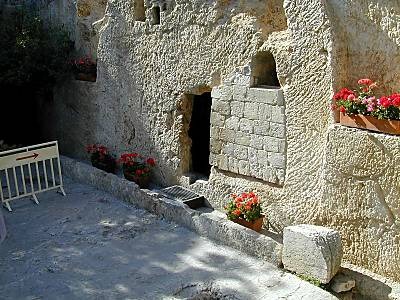
If you go to Jerusalem and want to visit the tomb where Jesus was buried, then, curiously, you will find that you have two options, the Church of the Holy Sepulchre or The Garden Tomb.

The contrast between the two sites is dramatic, one is a very old church with parts dating back to the fourth century, the other a modern garden. One dark, enclosed in the hustle and bustle of the Old City, with a sense of history and religious gravitas, and the other open and light, peaceful and quiet, situated just outside the city walls.

But they also have a lot in common.  I visited them a few years ago, and must admit, found the whole experience quite depressing, mainly because both sites felt contrived and unreal, like something fabricated for the punters, or more specifically, I suppose, designed for the pilgrims. More Disney than disciple, more Hollywood than holy.

But there is another major thing they have in common – they are both empty!  Not empty of visitors – because believe me they see plenty – but empty of a dead body, or remains of a dead body.

Ironically, this is what is expected. The pilgrims go and pay their money to see an empty tomb.

Because Jesus is risen. His body doesn’t lay in any tomb. He is alive!

Today is the day we remember this fact. Easter Sunday, Easter Day, Resurrection Day. It doesn’t matter what you call it. Today is the day when we remember that Jesus rose from the dead – death could not hold him, because there was nothing about him that deserved to die.

On Good Friday we remembered he was crucified, hung on a cross along side common criminals. Then after death laid in a borrowed tomb.

But on Sunday morning, the tomb is empty. The body is gone. Not stolen, but risen!

Death beaten. Sin conquered. Payment made.

The testimony of his friends and disciples proves it. He met them, walked with them. Talked with them, ate with them. He was back to be with them, and their despair and fear was immediately replaced by hope and purpose.

And he is still alive. Death couldn’t hold him then, and it will never hold him again.

He had fellowship with his disciples on that first Sunday, and he continues to have fellowship with his disciples today. He was there with them then and he is here with us now. Don’t look to an empty tomb for Jesus, because he’s not there, rather meet afresh today with a risen Saviour. Don’t mourn for a God who is dead, but rejoice in a God who is alive.

Good Friday? You’re having me on!

Pastedgraphic-2

I always find it bizarre that the Friday of Easter is called ‘Good’ Friday, and often wonder where the name came from.  How can the events that we remember today ever be described as ‘good’?  The Germans call it Mourning Friday (Karfreitag), the French Holy Friday (Vendredi Saint), but how did we come up with Good Friday?

I know, you can find many plausible reasons for the name through a simple Google search, but none of them say why we keep the name, when ultimately it doesn’t make any sense to the contemporary mind.

Or maybe we keep it for just that reason, because it doesn’t make any sense, because it hints of the paradox that is Easter, that through pain comes life, that through sorrow and mourning come joy and love.

As Chris Armstrong once wrote in Christianity Today (here)

“What a supreme paradox. We now call the day Jesus was crucified, Good. Many believe this name simply evolved—as language does. They point to the earlier designation, “God’s Friday,” as its root…Whatever its origin, the current name of this holy day offers a fitting lesson to those of us who assume (as is easy to do) that “good” must mean “happy.” We find it hard to imagine a day marked by sadness as a good day.

Of course, the church has always understood that the day commemorated on Good Friday was anything but happy. Sadness, mourning, fasting, and prayer have been its focus since the early centuries of the church. A fourth-century church manual, the Apostolic Constitutions, called Good Friday a “day of mourning, not a day of festive Joy.” Ambrose, the fourth-century archbishop who befriended the notorious sinner Augustine of Hippo before his conversion, called it the “day of bitterness on which we fast.”

Many Christians have historically kept their churches unlit or draped in dark cloths. Processions of penitents have walked in black robes or carried black-robed statues of Christ and the Virgin Mary. And worshippers have walked the “Stations of the Cross,” praying and singing their way past 14 images representing Jesus’ steps along the Via Dolorosa to Golgotha.

Yet, despite—indeed because of—its sadness, Good Friday is truly good. Its sorrow is a godly sorrow. It is like the sadness of the Corinthians who wept over the sharp letter from their dear teacher, Paul, convicted of the sin in their midst. Hearing of their distress, Paul said, “My joy was greater than ever.” Why? Because such godly sorrow “brings repentance that leads to salvation and leaves no regret” (2 Cor. 7:10)”.

Good Friday is not called ‘good’ because it is a day of happiness but because it is a day of sadness.  Why?  Because the sorrow we feel produces good in us – repentance that results in joy, love and surrender that leads to life.  Paradox.  It’s because it doesn’t compute, doesn’t make sense to our reasoned worldview that it has power.  Power to transform, to renew and revive. Power to do good in us, and through us.

A friend of mine posted the following on Facebook this morning:

“Of all the great engineering feats that mankind has built, none is greater than Calvary, where, with two rough planks of wood and four iron nails, the Carpenter of Nazareth spanned the gulf between heaven and earth”

That sums it up perfectly for me.  The greatest feat of engineering ever accomplished, to bridge the gap between me and God.  The gap opened by my selfishness and pride, but filled by God himself, nailed to a cross on Calvary.

Good Friday?  You’re having me on!

Well, maybe not good as in happy, but definately good!