Redefining masculinity for a ‘female’ world

Newsweek_man_up

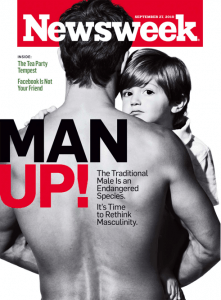
Newsweek had an article recently about the future of manhood in the US contemporary culture:

What’s the matter with men? For years, the media have delivered the direst of prognoses. Men are “in decline.” Guys are getting “stiffed.” The “war on boys” has begun. And so on. This summer, The Atlantic’s Hanna Rosin went so far as to declare that “The End of Men” is upon us.

There’s certainly some substance to these claims. As the U.S. economy has transitioned from brawn to brain over the past three decades, a growing number of women have gone off to work. Men’s share of the labor force has declined from 70 percent in 1945 to less than 50 percent today, and in the country’s biggest cities, young, single, childless women—that is, the next generation—earn 8 percent more than their male peers. Women have matched or overtaken men as a percentage of students in college and graduate school, while men have retained their lead in alcoholism, suicide, homelessness, violence, and criminality. Factor in the Great Recession, which has decimated male-heavy industries like construction and manufacturing, and it’s no wonder so many deadline anthropologists are down on men. But while the state of American manhood has inspired plenty of anxious trend pieces, few observers have bothered to address the obvious question: if men are going off the rails, how do they get back on track?

Read the full article here.

Also have a read of Al Mohler’s comment on the Newsweek article here – I don’t completely subscribe to Mohler’s view, but I do think his summary is pretty well on the mark:

A true masculinity is grounded in a man’s determination to fulfill his manhood in being a good husband, father, citizen, worker, leader, and friend — one who makes a difference, fulfills a role for others, and devotes his life to these tasks. Most of our fathers went to work early and toiled all day because they knew it was their duty to put bread on the table, a roof over our heads, and a future in front of us. They made their way to ball games and school events dead tired, went home and took care of things, and then got up and did it all over again the next day.

Today’s men are likely to be more nurturing, but they are also statistically less faithful. They may be changing more diapers, but they are also more likely to change spouses. Men must be encouraged and expected to be both faithful fathers and faithful husbands. Otherwise, any society is in big trouble.

The Newsweek cover story is an undisguised alert that the world is changing. A healthy masculinity should motivate men to find their way in this new world of changed economic realities and work opportunities, and to do this while remaining men. The unanswered question from Newsweek’s analysis is this: Will men change the new work of work, or will the new social realities change men?

Though barely mentioned in the article, the most haunting question is about today’s boys. The magazine’s cover features a shirtless man holding a young boy. It is the boy’s face that looks at the reader. We had better hope that the “new masculinity” of the uncharted future is one that leads that boy and his generation to become authentic and faithful men.

I think this is a problem in our contemporary culture for which we, the church, have a viable solution – bringing the hearts of men back to their families!

Neil Cole sums it up for me at the end of his book ‘Search and Rescue‘:

“Society is filled with problems, but trying to fix society one problem at a time is daunting and suffocating.  But it doesn’t have to be that way.  There are some problems that are root causes of others.  If we can identify and bring kingdom healing and restoration to those areas, scores of other problems will be resolved.

One such problem is the irresponsibility of men in our society, especially fathers.  If the hearts of the fathers returned to their children, and if fathers were faithful to their children’s mothers, street violence would subside, drug and sexual abuse would decrease, theft would drop, schools would improve, illiteracy would decrease, and dependency on teh state’s welfare system would diminish – releasing more tax revenue to address other problems.  Sexually transmitted disease would die down quickly.  Unwanted teen pregnancy rates would drop significantly.  The AIDS crisis would end.  The abortion issue, one of the most divisive issues of our day, would be resolved, not because of political lobbying and picket signs, but because the hearts of fathers would be turned back to their children.

You may think that this is a grand oversimplification, and perhaps to an extent it is, but I am thoroughly convinced that if men’s hearts were changed and men were challenged to live bold and authentic lives for Jesus – as heroes – our whole society would be changed in a short time.”

Now that is what I call ‘redefining’ masculinity – Jesus focussed with His kingdom as our priority – the way we were designed to be.
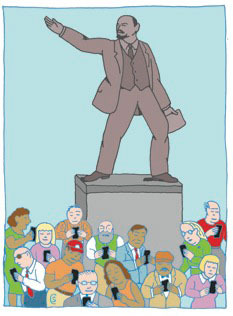
The ‘weak ties’ of social networking

Mark Sayers has posted an excellent (or molte bene to use his parlance) reflection on the Malcolm Gladwell’s New Yorker article mentioned in my previous post:

“This molto bene article from Malcolm Gladwell … has solidified a lot themes that I have been talking about on this blog for ages. Gladwell speaks about the relative weakness of social networking as a tool of social change versus the tied and tested methods of believing in something passionately and being really organised. Despite reading Clay Shirkey’s Here Comes Everybody and getting slightly excited, I have had this funny feeling for a while that what we are seeing a lot of hype over ways of reaching people with a lot of breadth but not a whole lot of depth.

If you haven’t yet read Here Comes Everybody then I would still recommend that you do – but must admit, as Sayers does, that Gladwell’s observations definitely throws new fuel on to the discussion about the weakness of wide but shallow social networks over ‘face-to-face’ relationships.

As Sayers observes:

“What loose, organic networks provide is breadth, a scope for communicating information across a broad spectrum of people. But as we all know the more invites you get on facebook the more you ignore them, the larger and looser the network the less effective it becomes. Real social change as Gladwell remarks is borne out of a deep commitment to the cause, and thus a deep connected engagement, something facebook activism, and ‘come as you are’ networks don’t provide.”

The contrast in both articles, therefore, is between ‘strong tie’ and ‘weak tie’ relationships, and, as Gladwell so eloquently illustrates, high-risk activism that catalyses real change is a “strong tie phenomenon” that is unlikely to appear through social networking:

“The platforms of social media are built around weak ties. Twitter is a way of following (or being followed by) people you may never have met. Facebook is a tool for efficiently managing your acquaintances, for keeping up with the people you would not otherwise be able to stay in touch with. That’s why you can have a thousand “friends” on Facebook, as you never could in real life.

This is in many ways a wonderful thing. There is strength in weak ties …. Our acquaintances—not our friends—are our greatest source of new ideas and information. The Internet lets us exploit the power of these kinds of distant connections with marvelous efficiency. It’s terrific at the diffusion of innovation, interdisciplinary collaboration, seamlessly matching up buyers and sellers, and the logistical functions of the dating world. But weak ties seldom lead to high-risk activism.”

Gladwell also makes the observation that high-risk activists are often organised hierarchically, which is not what social media is about:

“Facebook and the like are tools for building networks, which are the opposite, in structure and character, of hierarchies. Unlike hierarchies, with their rules and procedures, networks aren’t controlled by a single central authority. Decisions are made through consensus, and the ties that bind people to the group are loose.”

This doesn’t mean that loose networks are bad, just that they won’t, in Gladwell’s opinion, produce the type of relationships that facilitate hard social change:

“There are many things … that networks don’t do well. Car companies sensibly use a network to organize their hundreds of suppliers, but not to design their cars. No one believes that the articulation of a coherent design philosophy is best handled by a sprawling, leaderless organizational system. Because networks don’t have a centralized leadership structure and clear lines of authority, they have real difficulty reaching consensus and setting goals. They can’t think strategically; they are chronically prone to conflict and error. How do you make difficult choices about tactics or strategy or philosophical direction when everyone has an equal say? ….

The drawbacks of networks scarcely matter if the network isn’t interested in systemic change – if it just wants to frighten or humiliate or make a splash – or if it doesn’t need to think strategically. But if you’re taking on a powerful and organized establishment you have to be a hierarchy….”

As he concludes his article, Gladwell makes the observation that social networks are, ultimately:

“….a form of organizing which favors the weak-tie connections that give us access to information over the strong-tie connections that help us persevere in the face of danger. It shifts our energies from organizations that promote strategic and disciplined activity and toward those which promote resilience and adaptability. It makes it easier for activists to express themselves, and harder for that expression to have any impact. The instruments of social media are well suited to making the existing social order more efficient. They are not a natural enemy of the status quo.”

This makes sense, and must be taken into account, but is not necessarily all bad.  However, it does highlight the limits of social media in our contemporary culture.

Sayers takes this a step further and puts it into a discipleship context:

“What Gladwell is saying is that ultimately the methods of creating social change has not really changed that much. Commitment to a cause is infectious, but it is hard to catch across a computer screen or at a large event. It is caught in person. Therefore at the end of the day it is about discipling others …. Jesus was born into a culture where the apprenticing model of the Rabbis was normative …. Jesus’ statement that his followers must hate their families’ in order to be his disciples, so deeply shocking to our modern sensibilities, was actually not so shocking to Jesus hearers because it was a well know Rabbinical saying, underlying the importance of apprenticing yourself to a spiritual guide. Thus the challenge for us is to meld all of the tools which give us such breadth, with a challenge to go deeper. Screens – both on our laptops, iphones and stages can transfer important information. But the task of discipleship, of creating passionate followers prepared to die for a cause can only happen face to face.”

Ultimately, discipleship must be done face-to-face – and to be most effective, inevitably, on a one-to-one basis or in small groups of two or three – but the challenge is how to do this and still take advantage of the strengths of social media, primarily the easy transfer of information and ideas, and the fueling of innovation through collaboration with others outside of your normal circle of contacts.  Somewhere there must be a ‘sweet spot’ – to use Brafman and Beckstrom’s parlance – a place of best advantage between a centralised hierarchy and totally decentralised social network – where our discipleship focus is a hybrid of face-to-face apprenticing backed up and enhanced through networking with other disciples – both locally and across the global church.

The problem for me comes about when we put the responsibility for ‘discipleship’ exclusively in the hands of a local church hierarchy.  So often in such a situation ‘discipleship’ ends up becoming programme driven, legalistic and overly contrived rather than Jesus focussed, organic and natural.

Ultimately, the discipling of others must be driven from a grass roots change in the life of a church body – rather than a leadership directive – and that requires catalysts – people who have the passion and motivation to make change happen through influencing and encouraging others into action.

And as for me, my passion to disciple others, as a ‘catalyst’ in my home church, has been revived over the last eighteen months primarily as a result of my contact with key influencers, such as Mark Sayers, Alan Hirsch and Neil Cole – often through the use of social media.  The ties might be weak, but the influences, trust me, are strong!

Read Mark Sayers’ full article here.

The revolution will not be tweeted

Social_media_revolution

There was an interesting article by Malcom Gladwell in the New Yorker recently questioning the claim that social media is a contemporary aid to social activism and revolution:

The world, we are told, is in the midst of a revolution. The new tools of social media have reinvented social activism. With Facebook and Twitter and the like, the traditional relationship between political authority and popular will has been upended, making it easier for the powerless to collaborate, coördinate, and give voice to their concerns.

But is this the case?  Not according to Gladwell – read his full article here.

HT:  Alan Hirsch

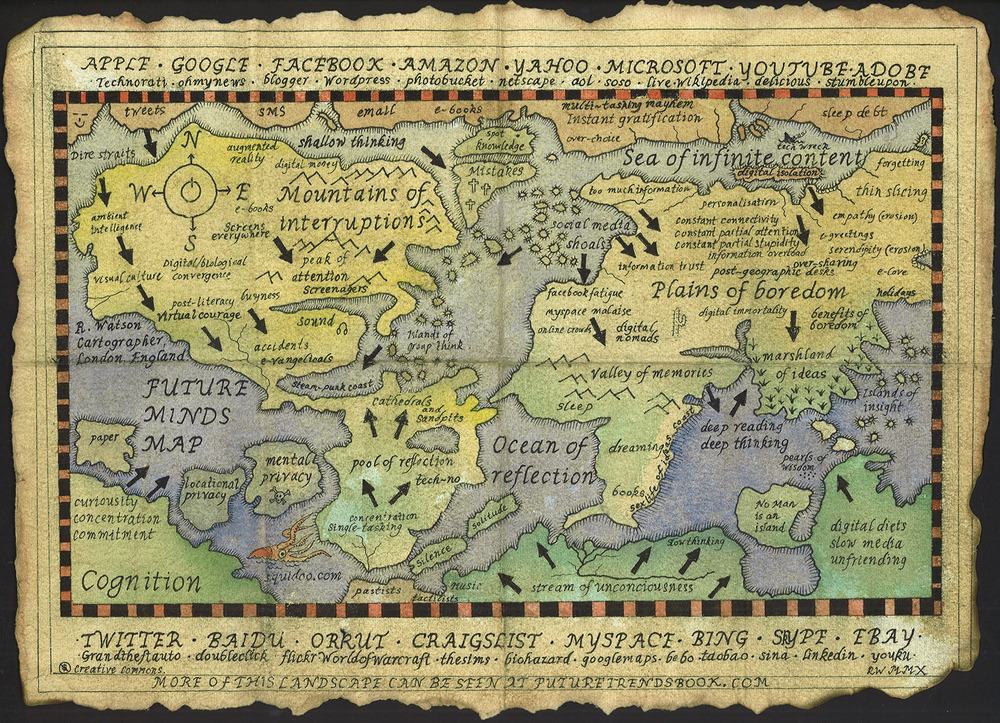
Mind map of the digital age

I saw this mind map by Richard Watson and thought it was interesting:

Future-mind-map-giant

As discussed on the Fast Company website, the specific things the map seeks to explore include:

Constant connectivity means we are constantly distracted. It’s now difficult to be truly alone. As a result we never get a chance to think deeply about who we are and where we are going. This links to Nicholas Carr’s point in The Shallows that our thinking is becoming hurried, cursory and superficial. Interesting counter-point here. We have never been so connected and yet U.S. research is showing that we have never felt so alone.

24/7 access to everything is creating a culture that values immediacy over and above almost everything else. We can no longer wait for things to happen. Again, this can give rise to a lack of rigour and reflection but it can also cause serious mistakes. I’d predict a single-tasking movement as a reaction against multi-tasking.

Digitalisation is creating too much information and choice. There is now so much to consider that we take shortcuts to knowledge. The result is a convergence of sources, which may reduce creativity and originality. For example, only 1% of Google searches now proceed past the first page of results and academic papers are now referencing fewer citations–not more as you might expect.

Generational shifts. Teens figure there’s no point in learning anything if you can just Google it. Moreover, trends like digital instant gratification and the shift towards interactive media mean that teens no longer have the patience to sit quietly and read. Does this mean that we are breeding a new generation with plenty of quick answers but very few deep questions? What will this mean for innovation?

Virtualisation means that we are removing the physical interactions that both people and ideas require. (i.e. both people and ideas are inherently social). Companies think that they can scatter people all over the world, give them access to a computer and expect something of great value to happen almost instantly but it rarely does. Will we perhaps see a back-sourcing counter-trend within the world of innovation, especially where R&D becomes concentrated in a single physical location rather then being distributed geographically?

Read the full article here.

Faith that matters – An interview with Philip Yancey

Yancy_by_randal_olsson

There is an interesting interview with Philip Yancy on the Christian Post site, mainly introducing his new book “What good is God?”, but there is also some nice insight about him as well:

Philip Yancey grew up in a strict, fundamentalist church in the Deep South.

He spent most of his early life in a bubble, attending a Bible college that in hindsight seems like “an island fortress against the outside world, one with its own private culture.” Even the Sixties’ sexual revolution did not penetrate the college’s sealed environment, he says.

The school’s list of forbidden activities included dancing, playing cards, skating at public rinks and movies, among others. Students could only play music “consistent with a Christian testimony;” women’s skirts were measured; and men could not grow a beard or moustache.

He went through a period of reacting against everything he was taught and later realized that “God had been misrepresented” to him.

Since then Yancey has explored some of the most basic questions of the Christian faith with a worldwide audience. His popular books include Disappointment with God and Where is God When it Hurts. His newest book explores the question “What good is God?”

It really is worth a read – find the full interview here.

Photo by Randal Olsson – copied from the Christian Post site.

Mark Sayers: God’s subversive cell – the family

Brilliant reflection by Mark Sayers:

What is uncool? Families! Nothing is as Unhip as a Honda Odyssey. Yet strangely despite our misgivings about family, the bible positions the family against the power of Empires and Nations as a subversive cell of change, a small grouping that contains the seeds of God’s redemptive action in the world.

I love the idea of the family as a subversive cell for God – making us realise that everything is not about us, and being the catalyst for change in a culture and/ or community.  If you think about it, this makes a lot of sense because so often broken communities are preceded or accompanied by an attack on the family, or the breaking up of family units into disparate, isolated individuals trying to get by on their own.

Desiring God National Conference 2010

Desiring_god

I would definately recommend that you take the time to listen to some of the talks from this years Desiring God National Conference – “Think: The Life of the Mind and the Love of God”.

A summary of all the various talks and discussion sessions can be found here.

Main talks are as follows:

Rick Warren – The Battle for Your Mind

R. C. Sproul – Thinking Deeply in the Ocean of Revelation: The Bible and the Life of the Mind

Thabiti Anyabwile – Thinking for the Sake of Global Faithfulness: Confronting Islam with the Mind of Christ

Albert Mohler – The Way the World Thinks: Meeting the Natural Mind in the Mirror and in the Marketplace

Francis Chan – Think Hard, Stay Humble: The Life of the Mind and the Peril of Pride

John Piper – The Life of the Mind and the Love of God

I recognise that most are speaking from a neo-Reformed theological perspective – but there is some very interesting and challenging stuff if you persevere 🙂

Any comments and/ or thoughts?